

The global healthcare and biotechnology landscape is undergoing a seismic shift, driven by the revolutionary potential of genome manipulation. The Gene Editing Market has transitioned from a specialized research tool to a multi-billion-dollar industry with the power to cure previously untreatable genetic disorders, enhance food security, and redefine precision medicine.

As we look toward 2032, the market is poised for exponential growth, fueled by technological breakthroughs like CRISPR-Cas9, base editing, and prime editing. This report provides a comprehensive analysis of the market size, share, key trends, and the strategic outlook for the next decade.
Market Size and Growth Projections
The gene editing market has entered a high-growth phase. As of 2024, the global market was valued at approximately USD 9.8 billion. Moving into 2026, the valuation is expected to reach USD 12.5 billion, driven by the commercialization of the first CRISPR-based therapies and increased R&D spending.
By 2032, the global gene editing market is projected to reach an estimated USD 29.9 billion, exhibiting a robust Compound Annual Growth Rate (CAGR) of approximately 15.5% during the forecast period.
Key Growth Indicators:
- Rising FDA/EMA Approvals: The 2023 approval of Casgevy for sickle cell disease marked a watershed moment, clearing the path for a pipeline of nearly 500 active clinical trials.
- Expansion into Agriculture: Beyond human health, gene editing is being utilized to create climate-resilient crops and nutritionally enhanced livestock.
- Investment Influx: Venture capital and government grants (such as the NIH’s SCGE initiative) are pouring billions into “off-the-shelf” (allogeneic) therapies.
Market Dynamics: Drivers and Restraints
The trajectory of the gene editing market is shaped by a complex interplay of scientific innovation and socio-economic factors.
Primary Drivers
- Prevalence of Genetic and Chronic Diseases: An aging global population and the rising incidence of cancer and rare genetic disorders (like Duchenne Muscular Dystrophy and Hemophilia) are creating an urgent demand for curative therapies.
- Technological Efficiency: The transition from early tools like ZFNs to the high-efficiency CRISPR-Cas9 system has drastically reduced the cost and time required for genome modification.
- Personalized Medicine: There is a growing shift toward “tailor-made” treatments where a patient’s own cells are edited to fight disease, particularly in oncology (CAR-T therapies).
Significant Restraints
- High Cost of Therapy: Gene-edited treatments often carry million-dollar price tags, posing challenges for insurance reimbursement and patient access.
- Ethical and Regulatory Hurdles: Concerns regarding germline editing (editing inheritable DNA) continue to spark global debate and lead to stringent, sometimes fragmented, regulatory frameworks.
- Off-target Effects: The risk of unintended DNA modifications remains a technical challenge that manufacturers must solve to ensure long-term patient safety.
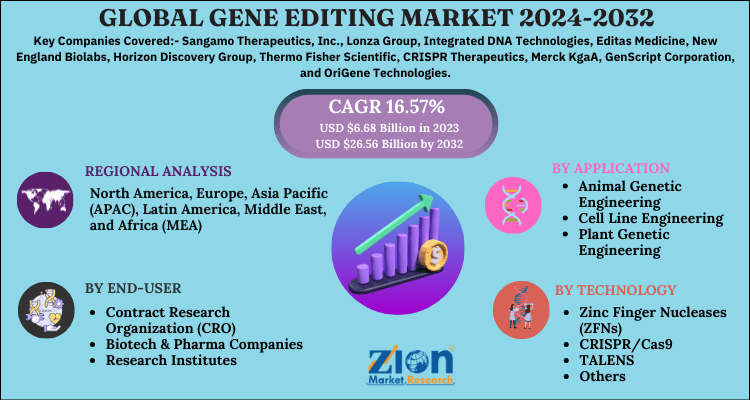
Market Segmentation
To understand the diversity of this sector, it is essential to analyze the market through various lenses: Technology, Application, and End-user.
- By Technology
- CRISPR-Cas9: Currently holds the largest market share (over 45%). Its simplicity and versatility make it the gold standard for both research and clinical applications.
- TALENs (Transcription Activator-Like Effector Nucleases): Valued for their high specificity, though more complex to engineer than CRISPR.
- ZFNs (Zinc Finger Nucleases): The “pioneer” technology, still utilized in specific therapeutic pipelines.
- Base & Prime Editing: The “Next-Gen” segments. These offer higher precision by allowing single-nucleotide changes without causing double-stranded DNA breaks, reducing the risk of errors.
- By Application
- Genetic Engineering: The largest segment, encompassing cell line engineering and animal model development.
- Therapeutic Development: The fastest-growing segment, focused on oncology, hematology, and infectious diseases.
- Agriculture & Food: Used to develop non-GMO crops that are resistant to pests and drought.
- By End-User
- Pharmaceutical & Biotechnology Companies: The primary revenue contributors, leading drug discovery and large-scale clinical trials.
- Academic & Research Institutes: Vital for early-stage innovation and tool development.
- Contract Research Organizations (CROs): Growing rapidly as smaller biotech firms outsource their gene-editing workflows to save on infrastructure costs.
Key Market Trends Shaping 2032
- The Rise of In Vivo Delivery
Historically, gene editing was often ex vivo (cells removed, edited, and returned). The trend is shifting toward in vivo delivery, where editing tools are delivered directly into the patient’s body using lipid nanoparticles (LNPs) or viral vectors. This simplifies the treatment process and broadens the range of treatable organs, such as the liver and heart.
- AI-Driven Guide RNA Design
Artificial Intelligence is being integrated into the gene-editing workflow to predict off-target effects and optimize guide RNA (gRNA) sequences. This significantly increases the safety profile and success rate of experimental therapies.
- Multiplexing Capabilities
Modern techniques now allow for “multiplexing”—editing multiple genes simultaneously. This is crucial for treating complex diseases like Type 2 diabetes or heart disease, which involve multiple genetic factors rather than a single mutation.
Regional Insights
| Region | Market Status | Key Growth Drivers |
| North America | Dominant (48% Share) | Advanced healthcare infrastructure, presence of industry giants (CRISPR Tx, Intellia), and high R&D funding. |
| Europe | Secondary Leader | Strong regulatory frameworks and growing biotechnology hubs in the UK, Germany, and France. |
| Asia-Pacific | Fastest Growing | Massive investments from China in agricultural biotech and a burgeoning biopharma sector in India and South Korea. |
| Rest of World | Emerging | Focus on infectious disease research and improving crop yields in Latin America and Africa. |
Competitive Landscape
The gene editing market is characterized by intense competition and strategic collaborations. Large pharmaceutical companies are increasingly acquiring or partnering with smaller CRISPR startups to bolster their pipelines.
Prominent Players include:
- CRISPR Therapeutics AG (Switzerland/USA)
- Intellia Therapeutics, Inc. (USA)
- Editas Medicine, Inc. (USA)
- Merck KGaA (Germany)
- Thermo Fisher Scientific Inc. (USA)
- Sangamo Therapeutics, Inc. (USA)
- Horizon Discovery Ltd. (Revvity) (UK)
- Beam Therapeutics (USA)
Conclusion
The Gene Editing Market is no longer a futuristic concept; it is a current reality that is reshaping the boundaries of biology and medicine. Between now and 2032, we expect a transition from “rare disease” solutions to “common disease” applications, potentially addressing global health crises like high cholesterol and chronic viral infections.
While high costs and ethical considerations remain significant hurdles, the continuous refinement of technologies like Prime Editing and the integration of AI will likely mitigate safety concerns and improve accessibility. For investors and stakeholders, the next seven years represent a critical window to capitalize on a technology that is fundamentally rewriting the code of life.
Read our Regional Reports>>
https://www.zionmarketresearch.com/de/report/gene-editing-market
https://www.zionmarketresearch.com/de/report/diamond-coatings-market
https://www.zionmarketresearch.com/de/report/elemental-sulfur-market
https://www.zionmarketresearch.com/de/report/electroactive-polymers-market
https://www.zionmarketresearch.com/de/report/qpcrreagents-market